If you click on a photograph, a larger version will open in a new window; close the new window when you have finished viewing the photograph. Video and audio clips may also open in a new window to allow continued downloading of the current page; close that blank window after the clip begins to download.

Photograph by Luke
Klein
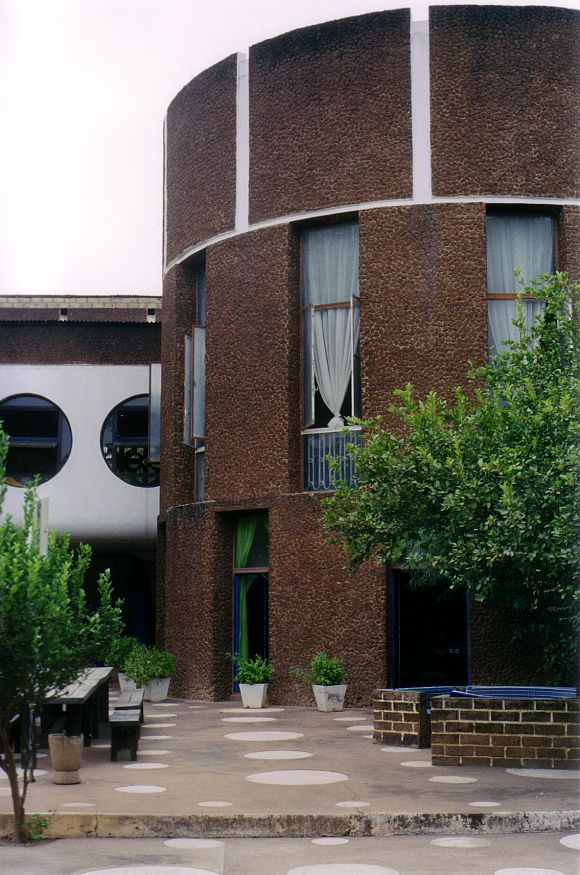
Luke: The hotel looks a lot nicer from this angle than it did the night before, when Daniel and I spent about 20 minutes trying to remove hairs from his sheets. We ended up sleeping in our clothes.
Aaron: There were lizards in the rooms and no hot water. But really, the place is OK.

Photograph by Aaron Javsicas

Photograph by Aaron Javsicas
Photograph by Aaron Javsicas

Photograph by David Scholnick
Dave: ...The people who worked at the hotel were much more obliging. Here's a guy waiting to sell us stuff.

Photograph by Aaron Javsicas

Photograph by Aaron Javsicas

Photograph by Aaron Javsicas

Luke: We arranged for a 4x4 to take us the rest of the way to the Senegal-Mali border.
Aaron: The 4x4 took us on the last portion of the Dakar-Bamako route for which a 4x4 is unnecessary.
Luke: Our driver, Alhassane, had to stop home before we left.
Daniel: He was very open with us. He was happy to have us at his home. We met his mother and brother, Thierno. He showed us his room where we checked out his music collection—a huge pile of cassettes—and saw his room's wallpaper of Ja Rule and Eve posters, along with some Senegalese soccer posters like no. 7, Henri Camara.

Photograph by Luke Klein

Photograph by David Scholnick

Photograph by David Scholnick

Photograph by Luke Klein
Luke: Alhassane's brother Thierno (right) and a friend
Dave: The boys had posters of American hip-hop stars, and we bragged that Eve was also from Philly. It was enough that we were from America, and being from Philly didn't give us any more cred.

Photograph by Aaron Javsicas

Photograph by Aaron Javsicas

Photograph by Aaron Javsicas

Photograph by Luke Klein
Daniel: Thierno and his crew got as many pictures taken as they could. As Alhassane pulled away in the 4x4, they were all running behind us in hopes of being captured on film a couple more times.
Photograph by Luke Klein

Photograph by David Scholnick
Luke: A bottle of 'Club Sept' helped get us through the long drive. 'Club Sept' is Senegal's finest blended "Scotch".
Daniel: Club Sept is some interesting stuff. I can't say it's good, but when we got back to Dakar I think we bought another bottle. This was a pleasant ride. Alhassane likes his radio hip hop, so he bumped Ja Rule, Busta Rhymes, and Nelly for most of our trip. He had two fairly hot mix tapes on rotation. I wasn't complaining.
Dave: Finally, some whiskey that was cheap enough that Luke couldn't complain.


Photograph by Luke Klein
Luke: We stopped for a meal (ceebu jën -- fish and rice) at a small village, Goudiry. The Senegalese usually eat with the fingers of the right hand, but they provided us with spoons. You can see the top of my little Purell bottle; it's a handy thing on this kind of trip.
Aaron: One particularly potent bite of pepper made Luke's head explode.
Daniel: The spice hurt so good, but those peppers were damn hot. Luke was a trooper, though. Halfway through the meal we realized there were fish bones in it; Luke kept eating. Alhassane had asked for vegetarian food for us (no beef, no chicken, no fish). The woman understood and as she served us up a huge bowl, she picked around, attempting to avoid all the beef, chicken, and fish in the pot. We didn't really know any of this until halfway through one of the best and spiciest lunches of my life, when we started coming across fish bones.

Photograph by David Scholnick


Photograph by David Scholnick

Photograph by Luke Klein

Photograph by David Scholnick

Photograph by Luke Klein
Luke: Upon crossing the Falémé River and arriving in Diboli (the Malian border town), we spent a while trying to find the border checkpoint. Once we found it, we sat in the small checkpoint office while the border guards shouted at some men whom they had apparently just arrested. The arrested men waited on benches along the wall while the soldiers checked our passports and visas. The soldiers were very friendly to us, but two problems arose that we feared might end our journey. First, these soldiers had not yet seen the new (computerized!) visas that the Malian embassy in D.C. had recently begun issuing (two of us had the new visa and two the old). Second, the soldiers insisted that we each needed to leave them an extra passport photo, which we did not have. And there was not a single passport camera or photocopy machine in Diboli. Finally, we convinced the soldiers that the new visas were legitimate, and they agreed to attach all of our declaration forms to a photocopy of Aaron's passport.
Dave: The border guards did a good job of seeming scary. They kept asking me for my visa, and I kept showing them my flashy new computerized visa with my picture on it. They'd say, 'Great, now show me your visa.'
Luke: As night fell, we piled into this small van along with spare tires, sacks of grain, and a total of 27 people. The 60-mile drive to Kayes on the pitted dirt road (the only road) took a painful 6 hours.
Aaron: We discovered the surprising fact that it is possible to undertake this trip (and far more arduous ones) without losing your mind.
Daniel: Though we didn't lose our minds, we came fairly close. I remember asking someone in our van—the 'vingt-deux places' (22-seater)—how long the trip was going to be. They said three hours, and it was six. I'm still not sure if we would have been more likely or less likely to go insane if we had known the truth all along.
Dave: I think we all agreed that we'd rather have this experience. An eight-inch bench went around the passenger area, paddy-wagon style. The kids and latecomers had to sit in the middle on top of the sacks of grain. The wind blew and the music blared. The sun went down, and my main impression of Mali was the dust. Sandy dust in my nose, my mouth, my ears, my hair. I couldn't see it, but just tasted red. Somehow, a few hours in, I had a four-year-old girl asleep on my lap. Her grandmother asked if it was okay. I said it was and tried my best to go to sleep myself. Chatting with the woman, she complained about the trip. She said that normally they took the train, which was also not good, but at least they were 'bien placé'.

Photograph by Luke Klein

Photograph by David Scholnick